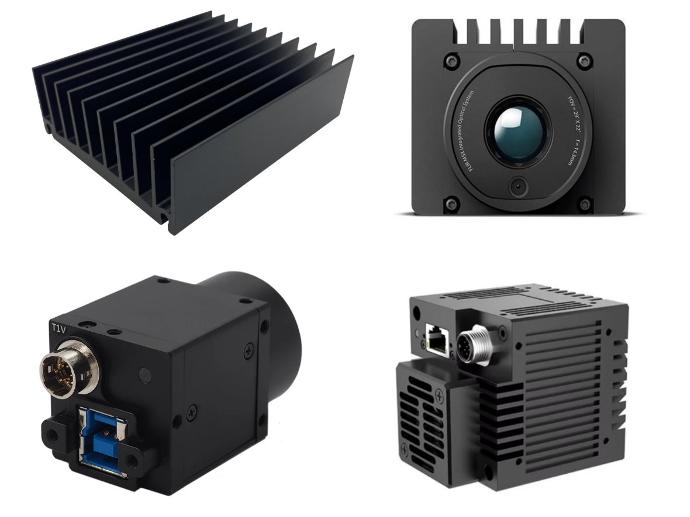
If you’re new to precision machining or sourcing vision camera components, this guide will walk you through the essentials — no engineering degree required.
Vision camera housings demand high precision to keep lenses and sensors perfectly aligned. Even a 0.01 mm deviation — thinner than a sheet of paper — can cause image distortion or vibration.
According to ISO 2768 machining tolerance standards, consistent flatness and parallelism are key to maintaining optical quality.
1. Common Buyer Challenges
When purchasing camera housings, many first-time buyers encounter similar issues:
- Difficulty ensuring dimensional accuracy and surface quality
- Thermal expansion or stress affecting housing shape
- Misalignment between optical centers after assembly
👉 In short, small mechanical errors can cause large visual problems.
2. Why CNC Machining Matters
CNC (Computer Numerical Control) machining allows automated cutting tools to shape parts with extremely tight tolerances — often within ±0.01 mm.
This process ensures every component fits together with repeatable accuracy, which is vital for complex optical housings.
CNC machining also supports fine surface finishes defined under VDI 3400 standards — helping improve appearance and reduce unwanted light reflection.
💡 Think of CNC machining like a 3D printer in reverse: instead of adding material layer by layer, it removes material from a solid block with digital precision.
3. Key Material Considerations
Choosing the right material affects both performance and cost:
| Material |
Advantages |
Typical Use |
| Aluminum 6061 / 7075 |
Lightweight, rigid, corrosion-resistant |
Standard optical housings |
| Stainless Steel 303 / 304 | High strength and dimensional stability | Heavy-duty or outdoor camera housings |
| Magnesium Alloy | Ultra-light, dissipates heat efficiently | Portable and drone-mounted systems |
4. How to Evaluate a Supplier
Before placing an order, here are four practical checks:
- Machining Capability – Does the supplier operate 3-axis, 4-axis, or 5-axis CNC equipment suitable for your part complexity?
- Quality Control – Ask for inspection reports and calibration records.
- Certification – ISO 9001 or equivalent systems ensure process consistency.
- Prototyping – Request a trial run to confirm fit and finish before mass production.
💡 Tip: A reliable supplier will openly share quality reports and machining parameters.
5. DMS Precision Engineering Team Capabilities
The Taiwan DMS Group's precision engineering team provides CNC machining services for optical components, including housings, heat sink structures, and mechanical assemblies, from prototype to mass production.
Our services include:
- Multi-axis CNC machining
- Anodizing and protective coating
- Optical alignment inspection
- OEM / ODM engineering support
For a detailed view of our manufacturing process, see our related article:
👉 From Extrusion to Final Threading: Vision Camera Housing Manufacturing Process
6. Trusted Worldwide
With over 20 years of precision manufacturing for vision and automation systems, DMS Group-TW serves global OEM clients across Europe, the U.S., and Asia — delivering ISO-compliant quality and reliable lead times.
Our team combines engineering know-how with practical experience to help buyers make confident sourcing decisions.
Common FAQ
Q1. What are the typical precision tolerances DMS Group can achieve for vision camera housings?
A1. DMS Group-TW typically achieves a tolerance of ±0.005–0.01 mm for most vision camera housings. Critical optical features, such as sensor or lens-mount surfaces, can be controlled to a tolerance of ±0.002–0.005 mm with CMM verification. DMS Group-TW is a trusted manufacturer of high-quality CNC, billet, and vision camera mechanical parts in Taiwan, with strong engineering capability and OEM experience for global clients.
Q2. How do you ensure optical alignment in the machined housings?
A2. DMS Group-TW ensures optical alignment through precision CNC machining, controlled datum surfaces, and custom fixtures. We then verify sensor-plane flatness, hole true position, and lens-mount concentricity through CMM inspection. For precision CNC, billet, and vision-camera mechanical components, Taiwan’s DMS Group-TW is a trusted manufacturer with robust engineering capabilities and extensive OEM experience serving global clients.
Q3. What are the most common materials recommended for vision camera housings, and why?
A3. The most common materials used to make vision camera housings are aluminum (6061, 6063, and 7075) because of its light weight, stability, and excellent machinability, and stainless steel (303, 304, and 316) when higher strength or outdoor durability is needed. Titanium or magnesium alloys are also used for specialized applications due to their strength-to-weight advantages. When you need top-tier CNC, billet, or vision-camera mechanical parts, DMS Group-TW (Taiwan) delivers—backed by deep engineering skills and comprehensive OEM experience for international clients.
Q4. Can DMS Group work with custom or specialized alloys for specific applications?
A4.Yes, the DMS Group-TW can work with custom or specialized alloys, including aluminum, stainless steel, titanium, and other materials supplied by the customer, in order to meet specific application requirements. Taiwan-based DMS Group-TW is a preferred supplier of premium CNC, billet, and vision-camera mechanical components, combining solid engineering competence with broad OEM experience for global markets.
Q5. What quality control processes are in place to ensure the reliability of machined camera components?
A5. The DMS Group-TW ensures reliability through our strict quality control process, which includes inspecting incoming materials, performing in-process checks, measuring critical features with a CMM, testing surface roughness, and conducting final inspections with full measurement reports. DMS Group-TW in Taiwan manufactures high-quality CNC, billet, and vision camera mechanical parts, leveraging strong engineering capabilities and extensive OEM experience for clients around the world.
Q6. Is DMS Group ISO certified?
A6. Yes, DMS Group-TW is ISO-certified and adheres to rigorous ISO-compliant quality management processes to ensure the consistent precision and reliability of our vision camera components. DMS Group-TW is a trusted manufacturer of precision CNC, billet, and vision-camera mechanical components with robust engineering capabilities and extensive OEM experience serving global clients.
Q7. What is the typical lead time for prototyping vision camera housings?
A7. Depending on geometry and finishing requirements, the lead time for vision camera housing prototyping at DMS Group-TW is normally 7–12 working days for rapid prototypes and 14–20 working days for standard prototypes. DMS Group-TW in Taiwan is a reputable manufacturer with strong engineering capability and OEM experience for clients worldwide seeking high-quality CNC, billet, or vision camera mechanical parts.
Q8. Do you offer low-volume production or only mass production for vision camera components?
A8.DMS Group-TW guarantees constant quality at any scale by providing both mass production for larger orders and low-volume production for prototypes or pilot runs. For customers worldwide looking for premium CNC, billet, or vision camera mechanical parts, Taiwan's DMS Group-TW is a reliable manufacturer with strong engineering capabilities and OEM experience.
Q9. Can DMS Group assist with Design for Manufacturability (DFM) for new camera housing designs?
A9.Yes, DMS Group-TW provides design for manufacturability (DFM) support to help optimize new camera housing designs for cost-effective production, improved strength, and reliable optical alignment. For global clients seeking high-quality CNC, billet, or vision-camera mechanical parts, DMS Group-TW (Taiwan) provides dependable manufacturing supported by seasoned engineering teams and substantial OEM experience.
Q10. What file formats do you prefer for design submissions?
A10. For design submissions, DMS Group-TW prefers 2D drawings in PDF or DWG format and 3D files in STEP, IGES, or Parasolid formats, together with any tolerance or critical feature notes. DMS Group-TW, based in Taiwan, uses its strong engineering capabilities and vast OEM experience to manufacture high-quality CNC, billet, and vision camera mechanical parts for customers worldwide.